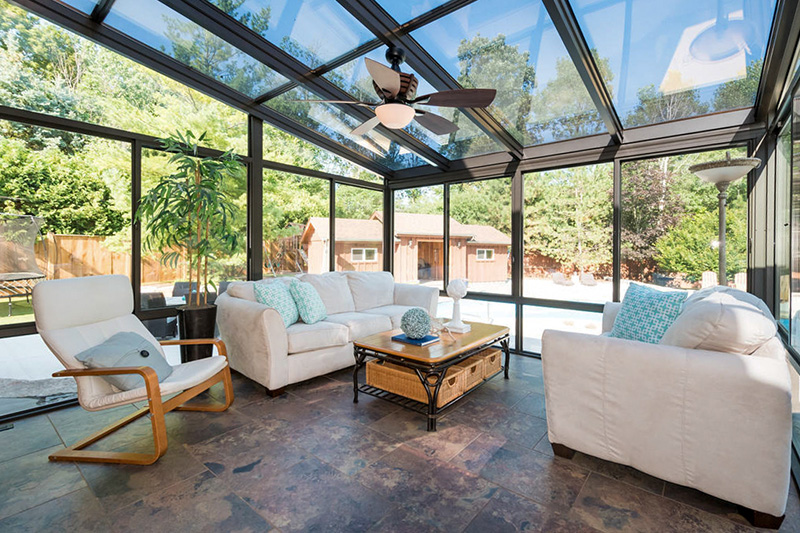
Many families build sunrooms to gain better lighting, expand living space and create a relaxing viewing area. However, most sunrooms become unbearably hot in summer. Excessive sunlight and high indoor temperatures make the space almost unusable. Many homeowners believe that sunrooms are naturally hot in summer and cold in winter. In fact,sunroom overheating is mainly caused by improper material selection, flawed structural design and insufficient heat insulation.
Without demolition and reconstruction, scientific insulation configuration, optimized ventilation and professional cooling design can effectively solve summer overheating problems. This article provides a complete set of practical cooling solutions for household, villa and terrace sunrooms.
1. Core Reasons Why Sunrooms Overheat in Summer
Three major factors lead to rapid temperature rise in sunrooms, which are also the most common decoration pitfalls:
Single-glaze effect with poor heat insulation: Ordinary tempered glass, single-layer glass and standard hollow glass cannot block infrared heat radiation. Direct sunlight accumulates massive heat indoors and forms a strong greenhouse effect.
Poor top ventilation and heat accumulation: Most sunrooms only adopt side windows with fully enclosed tops. Hot air gathers at the top with no effective exhaust channels, resulting in continuously rising indoor temperatures.
Weak heat insulation of profiles and sealing systems: Ordinary non-broken bridge aluminum profiles and simple sealing structures conduct outdoor heat rapidly, making thermal insulation ineffective.
2. Top Insulation Upgrade — Block Heat Radiation from the Source
More than 80% of indoor heat comes from the sunroom roof. Optimizing the top structure is the most efficient way to reduce temperatures.
1. Upgrade to Low-E thermal insulation glass
Ordinary glass only transmits light without heat insulation. Low-E glass effectively reflects infrared rays and solar thermal radiation, reducing indoor heat accumulation while maintaining high light transmittance. Matched with laminated hollow structures, it achieves excellent heat insulation, sound insulation and explosion-proof performance, serving as the standard configuration for high-end villa sunrooms.
2. Adopt multi-layer laminated hollow composite glass
Compared with single-layer tempered glass, the multi-layer hollow structure creates an effective thermal insulation air layer, greatly reducing heat conduction speed and preventing top heat accumulation. Meanwhile, it features high wind resistance, impact resistance and overall safety.
3. Ventilation Optimization — Eliminate Hot Air Accumulation
Perfect insulation cannot solve overheating without proper ventilation. Reasonable air circulation design quickly discharges indoor hot air and lowers room temperature.
1. Install electric top skylights
Hot air rises naturally, making top skylights the most effective heat dissipation structure. Electric skylights can open automatically at high temperatures, forming an upper-exhaust and lower-intake convection system that cools down the room rapidly in summer.
2. Design large side windows for cross ventilation
Equip the sunroom side walls with casement windows and sliding windows to form full air circulation with top skylights. Reasonable cross ventilation can reduce indoor temperature by 3-5℃ and eliminate stuffiness.
4. External Sunshade System — Low-Cost & High-Efficiency Cooling
For finished sunrooms that cannot modify glass structures, installing sunshade facilities is the most cost-effective improvement solution.
1. Outdoor electric retractable awning
Installed on the exterior of the sunroom roof, the electric awning blocks direct sunlight and isolates external heat fundamentally. It features flexible telescopic control, does not block the viewing vision, and delivers remarkable cooling effects with an elegant appearance.
2. Indoor intelligent thermal insulation curtains
Suitable for medium-budget renovation, double-layer thermal curtains and honeycomb shades effectively reflect heat radiation, prevent direct sunlight on floors and furniture, and relieve indoor stuffiness.
5. Profile & Structural Upgrade — Avoid Thermal Conduction & Heat Leakage
Most low-cost sunrooms adopt ordinary non-broken bridge aluminum profiles. These metal profiles conduct heat quickly and become extremely hot in summer, causing continuous indoor temperature rise.
High-end sunrooms adoptbroken bridge aluminum profiles with multi-channel sealing design. Professional thermal insulation strips block heat conduction, while high-quality EPDM sealing strips prevent water leakage, air leakage and dust ingress. This stable structure realizes a warm-in-winter and cool-in-summer sunroom environment.
6. Daily Usage Tips to Relieve Summer Overheating
1. Close doors and windows and unfold sunshades in daytime to avoid direct sunlight and heat accumulation;
2. Open skylights and side windows in the evening for natural convection and heat dissipation;
3. Equip fans or fresh air systems to accelerate air circulation and reduce stuffiness.
Conclusion
Summer overheating is not an inherent defect of sunrooms. It is caused byinferior materials, insufficient insulation, poor ventilation and lack of sunshade design. By optimizing top insulation, air convection, sunshade facilities and broken bridge structure, you can completely solve summer overheating and stuffiness problems, creating a comfortable sunroom space for leisure, viewing and daily relaxation all year round.


 2026-03-10
 Posted by: Huiyin